
Carbotech Manufacturing | Metal Fabrication in Roebuck, South Carolina
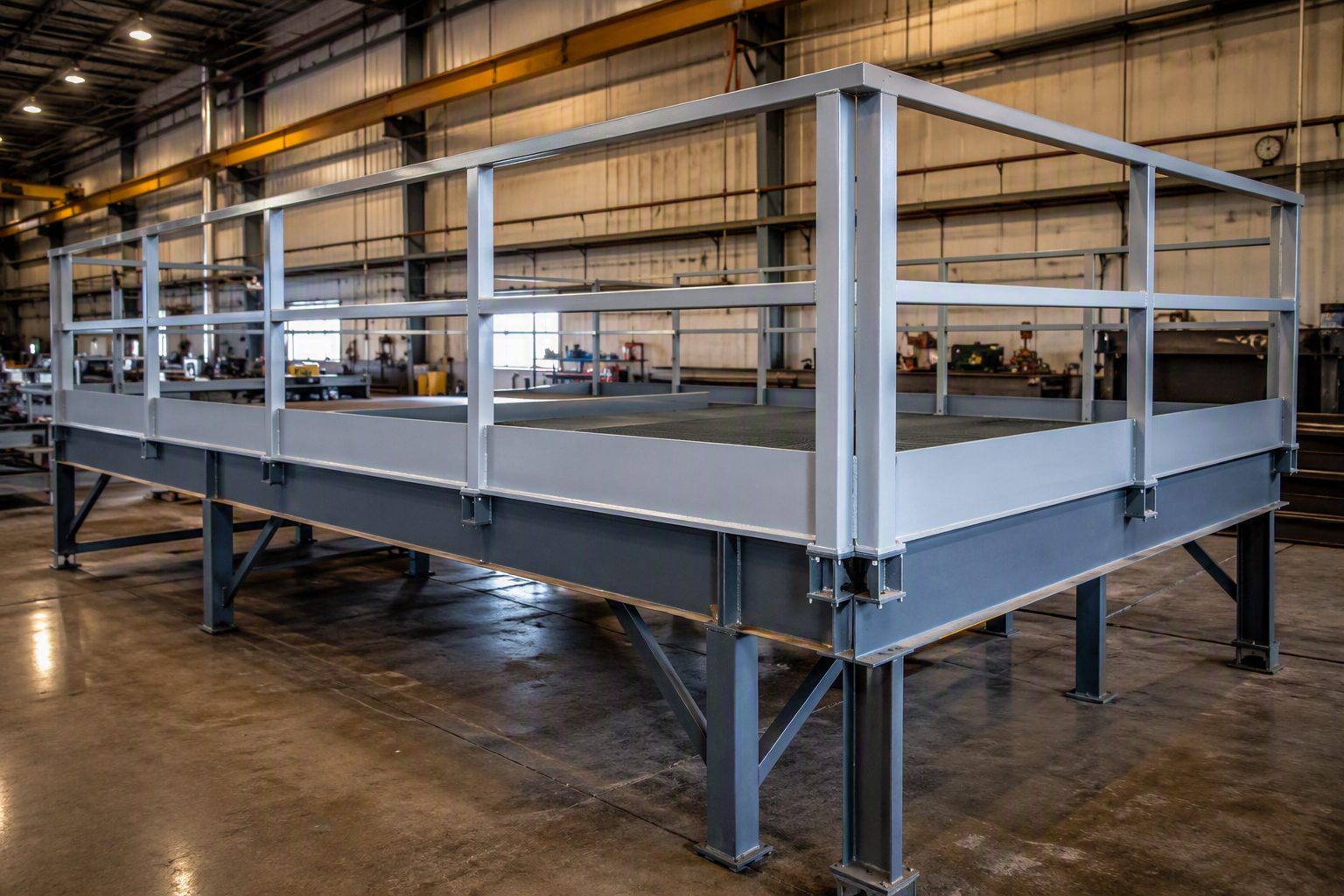
Guardrails on an industrial platform can be part of what a fabricator builds. A federal rule sets the dimensions and loads they must meet. Those numbers belong on the drawing before fabrication starts.
This article summarizes industrial platform guardrail requirements in OSHA’s general industry rule. Buyers can then put them on the drawing first. Carbotech Manufacturing is a full-service metal fabrication shop in Roebuck, South Carolina, cutting, welding, machining, assembling, painting, and inspecting in one 14,000 square foot building.
Where the Guardrail Rules Come From
OSHA’s walking-working surfaces rules for general industry include 29 CFR 1910.29. That section sets criteria for fall protection systems such as guardrails. OSHA issued the current section in November 2016 and amended it in December 2019.
The rule places the obligation on the employer, who is responsible for making each guardrail system meet the listed requirements. A fabricator builds what the drawing shows, so those requirements need to reach the drawing.
How high does a guardrail on an industrial platform need to be?
OSHA’s general industry rule, 29 CFR 1910.29, puts the top edge of a guardrail at 42 inches above the walking-working surface. The rule allows 3 inches either way. The top edge may go above 45 inches if the system meets all other guardrail criteria in that section.
Strength and Opening Criteria
Top rail strength. The system must withstand at least 200 pounds at any point along the top rail. The rule applies that force downward or outward within 2 inches of the top edge. Under that downward load, the top rail cannot deflect below 39 inches.
Intermediate members. Midrails, screens, mesh, balusters, and solid panels must withstand at least 150 pounds in any downward or outward direction. Where no wall or parapet reaches 21 inches, the rule calls for intermediate members. Options include a midrail set midway up, screens or mesh, or balusters no more than 19 inches apart.
Rail details. Top rails and midrails must be at least 0.25 inches thick or in diameter and smooth-surfaced. Steel and plastic banding cannot serve as rails. Rail ends cannot overhang posts where that creates a projection hazard. Guardrails on ramps and runways go along each unprotected side or edge.
How much force must an OSHA guardrail withstand?
OSHA’s 29 CFR 1910.29 requires a guardrail system to withstand at least 200 pounds. The force is applied downward or outward within 2 inches of the top edge. Under that downward load, the top rail cannot deflect below 39 inches. Midrails, screens, mesh, and other intermediate members must withstand at least 150 pounds.
Toeboards, Ladder Platforms, and the Drawing
Where toeboards protect workers below from falling objects, the rule sets a minimum height of 3.5 inches. Clearance above the walking surface cannot exceed 0.25 inches, and each toeboard must withstand at least 50 pounds. Platforms used with fixed ladders must provide a horizontal surface of at least 24 by 30 inches. Covers over holes in a walking-working surface must support at least twice the maximum intended load. Those covers also have to be secured against accidental displacement.
Carbotech’s engineers read the drawing, the connections, and the load callouts before quoting. The shop builds platforms, supports, and framing, with cutting, welding, assembly, and paint in one building. Members get checked against the drawing before shipment.
Buyers planning structural steel fabrication can also review who owns what between the engineer of record and the fabricator. Related reading covers structural steel prices in 2026 and aluminum, stainless, or mild steel for industrial platforms.
Frequently Asked Questions
Who is responsible for meeting OSHA guardrail requirements on a platform?
Under 29 CFR 1910.29, the employer is responsible for making sure each guardrail system meets the rule’s requirements. A fabricator builds to the engineered drawing. Guardrail dimensions and loads need to appear on that drawing before fabrication. Buyers should confirm specific requirements with a safety professional or the engineer of record.
What is the OSHA stair rail height requirement?
Under 29 CFR 1910.29, stair rail systems installed on or after January 17, 2017 must be at least 42 inches high. The rule measures from the leading edge of the stair tread to the top surface of the top rail. Handrails must be between 30 and 38 inches high, measured the same way.
Who fabricates industrial platforms in Upstate South Carolina?
Carbotech Manufacturing fabricates industrial platforms, supports, and framing in Roebuck, South Carolina. The plant sits at 129 Old Airport Road in Spartanburg County. The shop works in aluminum, stainless steel, and mild steel. The plant opened in 2023 as part of Carbotech Group, founded in Quebec in 1987.
Carbotech Manufacturing: One Floor, Every Operation
Carbotech Manufacturing cuts, welds, machines, assembles, paints, and inspects in one 14,000 square foot building in Roebuck, South Carolina. The plant opened in 2023 as the US operation of Carbotech Group, which has built log handling and wood processing equipment from Quebec since 1987.
Our Services Include:
- Custom Metal Fabrication: Aluminum, stainless, and mild steel, from single pieces through repeat runs
- Material Handling Systems: Conveyors, platforms, and handling equipment designed, built, painted, and installed by one team
Have a print or a bottleneck?
Send it over with material, quantity, and the date you need parts on the ground.
This article is general information about federal regulations and is not a substitute for OSHA guidance, a qualified safety professional, or an engineer’s assessment of a specific application.
Related Articles
- Engineer of Record vs. Fabricator: Who Owns What in Structural Steel
- Structural Steel Prices in 2026: What Federal Data Shows
- Aluminum, Stainless, or Mild Steel for Industrial Platforms and Supports
Works Cited
Occupational Safety and Health Administration. “29 CFR 1910.29, Fall Protection Systems and Falling Object Protection: Criteria and Practices.” Electronic Code of Federal Regulations, www.ecfr.gov/current/title-29/part-1910/section-1910.29. Accessed 15 Sept. 2026.
