
Carbotech Manufacturing | Metal Fabrication in Roebuck, South Carolina
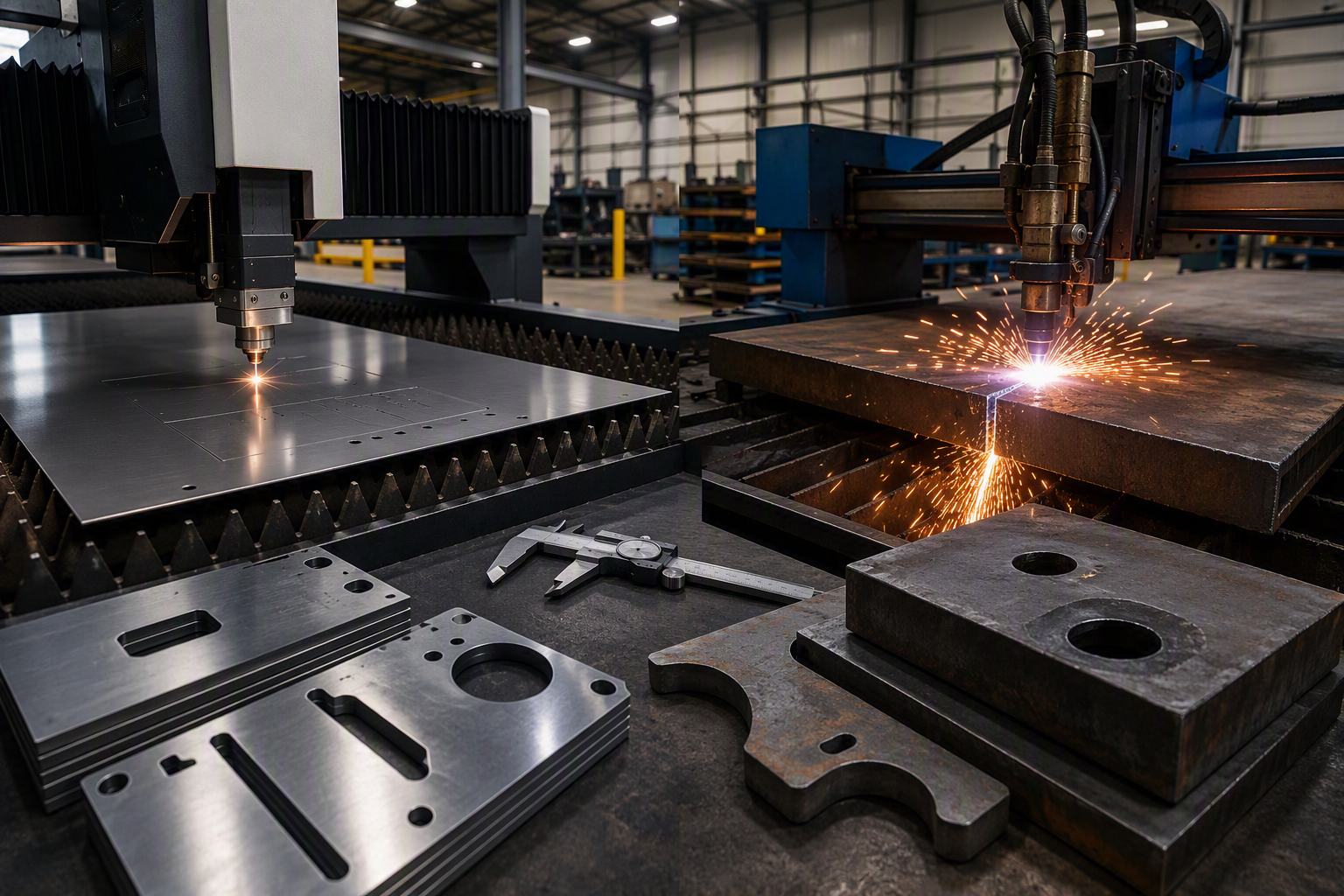
Laser and plasma cutting both use heat to cut metal, and both show up in fabrication quotes. The right choice depends on factors that include the material, its thickness, and what the finished edge has to do.
This article compares laser cutting vs. plasma cutting using the international standard that classifies thermal cuts. Carbotech Manufacturing is a full-service metal fabrication shop in Roebuck, South Carolina, cutting, welding, machining, assembling, painting, and inspecting in one 14,000 square foot building.
How Laser and Plasma Cutting Work
Laser cutting focuses a beam on the metal. According to Carbotech, the beam melts a narrow path through the sheet. Assist gas clears the molten metal from the cut. Nothing touches the material during the cut.
Plasma cutting uses a constricted electric arc and a high-velocity gas. The arc melts the metal, and the gas blows it out of the cut. Both processes fall under ISO 9013:2017, the international standard for classifying thermal cuts. Oxyfuel flame cutting is covered too.
What is the difference between laser and plasma cutting?
Laser cutting melts metal with a focused beam and clears it with assist gas. Plasma cutting melts metal with a constricted electric arc and blows it out with gas. ISO 9013:2017 applies to laser cuts from 0.5 to 32 millimeters thick and plasma cuts from 0.5 to 150 millimeters. Plasma’s classified range reaches much thicker material.
How Thickness Separates Laser and Plasma Cutting
The International Organization for Standardization publishes ISO 9013:2017, which sets geometrical product specifications and quality tolerances for thermal cuts. ISO confirmed the standard in 2022 and issued an amendment to it in 2024. The 2017 edition replaced ISO 9013:2002, which had applied to laser cuts up to 40 millimeters, so a drawing that cites the older edition points to different ranges.
Its scope sets a different thickness range for each process. The laser range runs from 0.5 to 32 millimeters, or roughly 0.02 to 1.26 inches. The plasma range runs from 0.5 to 150 millimeters, up to about 5.9 inches. Oxyfuel flame cutting spans 3 to 300 millimeters.
Those ranges mark where the standard’s quality classifications apply. They are not the rated capacity of any individual machine, so the practical limit on a job depends on the shop’s equipment. At Carbotech, the Mazak 510 laser cuts up to one inch thick. Heavier sections move to the Hypertherm plasma cutter, the saw, or the 60 ton ironworker.
How thick can a laser cut steel?
Laser cutting thickness depends on the machine. ISO 9013:2017 applies to laser cuts up to 32 millimeters, about 1.26 inches, but that marks the standard’s range rather than a machine’s capacity. Carbotech Manufacturing in Roebuck, South Carolina cuts steel up to one inch thick on a Mazak 510 laser with a five by ten foot bed.
How ISO 9013 Measures Cut Quality
Carbotech notes that ISO 9013 classifies thermal cuts using measurable criteria, including perpendicularity and surface roughness. Cut quality then becomes something a buyer and a shop can agree on in writing.
Two details in the standard’s scope matter when writing a drawing. Its specifications apply when a drawing or a related document, such as delivery conditions, references the standard. The standard does not address flatness defects as such, so flatness requirements need to be specified separately.
Carbotech’s guidance is to state any required edge condition at quoting rather than after delivery.
How is laser cut quality measured?
Laser cut quality can be specified against ISO 9013:2017, the international standard for classifying thermal cuts, using criteria that include perpendicularity and surface roughness. The specifications apply when a drawing or related document references the standard. Buyers who need a specific edge condition should state it when requesting a quote.
Choosing a Process by Material and Part Size
Material matters alongside thickness. Carbotech’s laser cuts aluminum, stainless steel, and mild steel, and each behaves differently through the cut. Thickness drives the machine settings and the resulting edge condition. For that reason, the alloy and thickness belong in the quote request.
Part size is another constraint. The Mazak 510’s five by ten foot bed sets the largest single part it can cut in one piece. Carbotech builds larger assemblies from multiple cut pieces welded together in the same shop.
For the full list of details a fabricator needs, see what to send a metal fabricator for a quote. The service page for Carbotech’s laser cutting services lists materials and capacity.
Should I choose laser or plasma cutting for my parts?
The choice depends on factors including material thickness, the alloy, and the edge condition the drawing requires. The laser range in ISO 9013:2017 ends at 32 millimeters, while its plasma range extends to 150 millimeters. Carbotech Manufacturing in Roebuck, South Carolina runs both processes and routes material by thickness and section.
Where Cutting Fits in the Rest of the Job
Cut parts are often the first step in a larger job. At Carbotech, the shop deburrs cut parts and checks them against the drawing. From there they either ship as blanks or move to welding, machining, assembly, and paint in the same building.
That flow links cutting to custom metal fabrication and to repeat build-to-print work through contract manufacturing. Buyers outsourcing ongoing production can start with how to choose a contract manufacturer. Cut components that feed a conveyor or platform tie into custom material handling systems: what to define before you build.
Frequently Asked Questions
Can a laser cut aluminum and stainless steel?
A laser can cut aluminum and stainless steel as well as mild steel. Each metal behaves differently through the cut. Carbotech Manufacturing in Roebuck, South Carolina cuts all three on a Mazak 510 up to one inch thick. Buyers should send the alloy and thickness so the shop can confirm what the machine holds.
Does laser cutting require tooling?
Laser cutting requires no dies and no punches. That means no tooling to build or amortize, unlike a stamped part. At Carbotech Manufacturing in Roebuck, South Carolina, one prototype and a production batch can run from the same file on the Mazak 510.
What size parts can a laser cut in one piece?
The laser bed sets the largest part a machine can cut in one piece. Carbotech Manufacturing’s Mazak 510 in Roebuck, South Carolina has a five by ten foot bed and cuts up to one inch thick. The shop builds larger assemblies from multiple cut pieces welded together in the same building.
Who offers laser cutting services in Upstate South Carolina?
Carbotech Manufacturing offers laser cutting services at 129 Old Airport Road in Roebuck, South Carolina, in Spartanburg County. The 14,000 square foot plant runs a Mazak 510 laser cutting aluminum, stainless steel, and mild steel up to one inch thick. The plant opened in 2023 as part of Carbotech Group, founded in Quebec in 1987.
What happens to parts after laser cutting?
At Carbotech Manufacturing in Roebuck, South Carolina, the shop deburrs laser-cut parts and checks them against the drawing. Customers can collect the cut blanks. They can also have the same shop weld, machine, assemble, and paint the parts into a finished unit. Keeping those steps in one building removes a shipping leg from the schedule.
Carbotech Manufacturing: One Floor, Every Operation
Carbotech Manufacturing cuts, welds, machines, assembles, paints, and inspects in one 14,000 square foot building in Roebuck, South Carolina. The plant opened in 2023 as the US operation of Carbotech Group, which has built log handling and wood processing equipment from Quebec since 1987.
Our Services Include:
- Custom Metal Fabrication: Aluminum, stainless, and mild steel, from single pieces through repeat runs
- Material Handling Systems: Conveyors, platforms, and handling equipment designed, built, painted, and installed by one team
Have a print or a bottleneck?
Send it over with material, quantity, and the date you need parts on the ground.
Related Articles
- Custom Material Handling Systems: What to Define Before You Build
- Custom Metal Fabrication Quotes: What to Send Before Parts Get Cut
- How to Choose a Contract Manufacturer for Build-to-Print Work
Works Cited
International Organization for Standardization. ISO 9013:2017, Thermal Cutting: Classification of Thermal Cuts: Geometrical Product Specification and Quality Tolerances. ISO, 2017, www.iso.org/standard/60321.html. Accessed 15 Sept. 2026.
